2026 CPS-IoT Week Day 2
Table of Contents
- Table of Contents
- Keynote: Sensing
- SenSys: Little Whispers & Battery-Free Hugs
- 3in1: Multi-Tone Joint Powering, Clocking, and Communication for Passive IoT
- B3: Bistatic Backscatter Beamforming for mmWave IoTs Zhenzhe Lin (George Mason University);
- SharpPeak: Unlocking the True Potential of Tunnel Diodes for Low-Power Long-Range Communication
- Bringing All Modulations to Underwater Backscatter via PDM-Synthesis
- Piezo-Ultrasonic Backscatter: Low-Power High Throughput Underwater Networking
- A Single-Chain Analog Backscatter Tag for Multi-Sensor Multiplexing
- Longan: Ultra-Low-Power, Long-Range LoRa Receiver for LPWANs
- Enabling Cross Technology Communication from LR-FHSS to LoRa
- μMan:Towards Device-Agnostic Power Management for Battery-free IoT
- Deform to Inform: Persistent Batteryless Sensing via Antenna Deformation and RFID Impedance Adaptation
- Cheetah: A New Paradigm for Battery-free Wearable Devices
- Enabling Active Sensing with Zero-Power Components
- SenSys: I See You: Peeking Through the Waves
- Towards Practical Bi-Static Polarimetric Imaging Using Commodity mmWave Radars for Material Sensing
- Surface Material and Roughness Sensing Using mmWave via Surface Scattering and Ambient Vibrations
- MetaPolar: A Low-Cost, Passive, mmWave Radar-Readable Metasurface Road Sign
- Sense with Polyface Mirror: Enhancing Wi-Fi Sensing Diversity via Programmable Metasurfaces
- Millimeter-Scale Absolute Carrier Phase-Based Localization in Multi-Band Systems
- 0cal: Zero-Cost Calibration for mmWave Networks
- mmAnomaly: Leveraging Visual Context for Robust Anomaly Detection in the Non-Visual World with mmWave Radar
- GigaFlex: Contactless Monitoring of Muscle Vibrations During Exercise with a Chaos-Inspired Radar
- OmniPC: A Generalizable Point Cloud Generation Pipeline for mmWave Radar
- MIRO: Multi-Radar Identity and Ranging for Occupational Safety
- Motion Capture with Millimeter-Wave Tags
- Stereo-Fi: Free-Form 3D Reconstruction via Generatively Co-Trained Inverse RF Rendering
- MagLens: Bringing Mobile, Fine-Grained Imaging to Ferrous Building Structures
- Posters and Demos
Keynote: Sensing
Prof. Xia Zhou, Columbia University
- Uncertainty scales with number of sensors
- Two types of human sensing
- Physical states (gesture, activates)
- physiological (ekg)
- Challenges
- Motion noise
- User diversity
- Limited compute
- Joey senses kangaroo mother care (KMC)
- Uses conductive fabrics to infer ECG of mother and child
- Designed to be a necklace which goes on the front/back of the mother
- Uses adaptive filter, and deep diffusion deionising to handle the noise
- Conditionally activate deep diffusion for battery lifetime
- PillowSense, Sleep monitoring
- Multilayer sensing fabric
- Sleep posture and vital signs
- Use embroidery to mitigate noise
- Has automated sewing machine
- Preventing deepfakes for High profile videos (Verilight)
- All recorded videos can be verified without need for users
- Transfer burden of verification to the speaker
- Dynamic light patterns will be directed to the camera with the signature
- Analyzing speakers face
- Signature can be done for any portion of a video
- Project the signature on a background??
- Can’t tell if its being sent to camera of the background
- Can find the timestamp of the fake
- https://mobilex.cs.columbi.edu/verilight
- Future work looks at adding this with sound
- Sensing is about establishing trust
SenSys: Little Whispers & Battery-Free Hugs
3in1: Multi-Tone Joint Powering, Clocking, and Communication for Passive IoT
Ruirong Huang, Renjie Zhao (Johns Hopkins University)
- Passive sensors are limited by downlink range
- Single waveform for power, clock, and comm
- Using multi-tone carrier waves
- Something with harmonics
Don’t fully understand the tech here
B3: Bistatic Backscatter Beamforming for mmWave IoTs Zhenzhe Lin (George Mason University);
Yoon Chae (University of Texas at Arlington); Mingyo Jeong, Parth Pathak (George Mason University)
- mmWave allow for large bandwidth with low power
- mmComb precursor work
- Need to do beamforming between TX and RX, bistatic beamforming
- Has hardware github website
- Results in lower BER compared to existing platforms
Precursor to radar backscatter work
SharpPeak: Unlocking the True Potential of Tunnel Diodes for Low-Power Long-Range Communication
Madhushanka Padmal, Dilushi Piumwardane (Uppsala University); Thiemo Voigt (Uppsala University, RISE)
- Activie TX with less than 200 uW power
- Existing radios are in the mW range
- Aiming to reduce power consumption though oscillator
- Tunnel diodes, able to generate high frequency oscillation
- Solving phase noise and harmonics
- Seems to be able use as a clock
Oscillator for RF backscatter tags
Bringing All Modulations to Underwater Backscatter via PDM-Synthesis
Waleed Akbar (MIT); Ahmed Allam (MIT, University of Cincinnati); Nazish Naeem, Fadel Adib (MIT)
- Underwater backscatter communication
- Underwater channel is a hard envirnment
- Custom modulation that compatible with backscatter
- Arbitrary modulation backscatter (AMB)
- Use digital oversampling or PDM
- Uses the node transducer as a low pass filter for HF noise
- Choose modulation based on the SNR
- Outperforms traditional OOK modulation
- 850 uW, more than vanilla backscatter
Piezo-Ultrasonic Backscatter: Low-Power High Throughput Underwater Networking
Purui Wang, Weitung Chen, Waleed Akbar, Fadel Adib (MIT)
- Enable ultra low power imagery
- Existing has 186 sec per frame
- Problems: (1) limited bandwidth and (2) spectral inefficiency
- Ulrasonci underwater backscatter system
- Single-sideband for modulation
- Discretized Hulibert Transform wiht minimal difference compared to discrete
- Now 4.5s per frame
- https://sk-exp-server.mit.edu
- 10mW for TX
- 750uW for backscatter
A Single-Chain Analog Backscatter Tag for Multi-Sensor Multiplexing
Yijie Li, Weichong Ling (National University of Singapore); Taiting Lu (Pennsylvania State University); Bao Dao (University of Massachusetts Amherst); Yi-Chao Chen (Shanghai Jiao Tong University); Vaishnavi Ranganathan (Microsoft Research); Lili Qiu (UT Austin); Jingxian Wang (National University of Singapore)
- Table to have multiple sensors using the same backscatter communication link
- MATRIX
- Voltage division multiplexing to encode RF frequency shifts
- HMM-based signal reconstruction
- support up to 7 sensors
- Only 5 sensors used for robustness
Longan: Ultra-Low-Power, Long-Range LoRa Receiver for LPWANs
Mingzhe Li (City University of Hong Kong); Tao Chen (Independent Researcher); Zhenjiang Li (City University of Hong Kong)
- Addressing two power sinks
- Frontend, Replace BJT with tunnel diode
- Demod, always on LF detector to wakeup radio
- Use scheme for aligning packets with trigger?
- Allow for always on class-C on battery
- Integrated with LoRaWAN directly?
Enabling Cross Technology Communication from LR-FHSS to LoRa
Md Ashikul Haque, Aakriti Jain (University of Texas at Dallas); Prashant Modekurthy (University of Nevada, Las Vegas); Abusayeed Saifullah (University of Texas at Dallas)
- LR-FHSS reverts to LoRaWAN for downlinks
- Aiming to enable LoRa and LR-FHSS TX/RX from the node
- RX previously not possible
- Remove randomness from LR-FHSS
- On the receiver have a deconstruction stage between lora frontend and demod
Can use with HARE’s radio network
μMan:Towards Device-Agnostic Power Management for Battery-free IoT
Chong Zhang (University of Electronic Science and Technology of China, and Southwest Petroleum University); Han Wang, Qianhe Meng, Yize Zhao (University of Electronic Science and Technology of China); Shengyu Li, Songfan Li (University of Electronic Science and Technology of China, The Hong Kong University of Science and Technology); Zetao Gao, Li Lu (University of Electronic Science and Technology of China); Hongzi Zhu (Shanghai Jiao Tong University)
- Low power devices requre refined battery management
- Reduce the energy cost for battery management
Deform to Inform: Persistent Batteryless Sensing via Antenna Deformation and RFID Impedance Adaptation
*Haochen Zhao (University of California, Los Angeles); Vishnu Naidu (University of California, San Diego); Shanmu Wang (University of California, Los Angeles); Kenneth J. Loh (University of California, San Diego); Omid Abari (University of California, Los Angeles)
- Monitoring refrigerated resources for exceeding guidelines
- Think meat transportation
- Mechanical deformation of antenna based on temperature/humidity
- Can use existing RFID readers
- Material deformation based on temperature
- PVA used for humidity
Cheetah: A New Paradigm for Battery-free Wearable Devices
Vivian Dsouza, Przemysław Pawełczak (Delft University of Technology); Alessandro Montanari, Ashok Samraj Thangarajan (Nokia Bell Labs)
- Issues with adoption:
- Charging time
- Inconsistent power sources
- ??
- Qi charging for batteryless wearable devices
- Open source GitHub repository
- “TAP to Sync” able to sync with your phone
- 20 EUR for single prototype
Possibly integrate this with ENTS?
Enabling Active Sensing with Zero-Power Components
Mingqi Xie, Qinyu Wang, Meng Jin, Fengyuan Zhu, Jiaxin Ding, Xinbing Wang (Shanghai Jiao Tong University); Chenghu Zhou (Chinese Academy of Sciences)
- Carrier free TX
- Piezoelectric for pulse generation
- Can determine speed/force
- Size determines the encoding capacity
- Like a battery free wireless switch
- 1-2m communication range
SenSys: I See You: Peeking Through the Waves
Towards Practical Bi-Static Polarimetric Imaging Using Commodity mmWave Radars for Material Sensing
Xinghua Sun, Akshay Gadre (University of Washington)
- Identify materials
- Adding polarization dimension
- Multiple radars give polarization
Surface Material and Roughness Sensing Using mmWave via Surface Scattering and Ambient Vibrations
Yawen Liu, Bert Shan, Swarun Kumar (Carnegie Mellon University)
- Identifying surface roughness and material
- Motivated by force sensing in robotics
- Leverage ambient vibration for sensing
- mmTexora
MetaPolar: A Low-Cost, Passive, mmWave Radar-Readable Metasurface Road Sign
Kai Zheng, Wuqiong Zhao, Xinyu Zhang (University of California San Diego)
- 5G-V2X infrastructure to vehicle communication adapted in Europe
- Passive mmWave radar readable sign
- Chipless PCB with FR4 material for metasurface
- Use a custom 60 MHz radar
- Have horizontal/vertical poles
Sense with Polyface Mirror: Enhancing Wi-Fi Sensing Diversity via Programmable Metasurfaces
Long Fan (Nanjing University); Yinghui He (Nanyang Technological University); Lei Xie (Nanjing University); Serene Zhang (Raffles Institution); Jun Luo (Nanyang Technological University)
- Using multiple metasurfaces for human position detection
- NN for decoding and processing of data
Millimeter-Scale Absolute Carrier Phase-Based Localization in Multi-Band Systems
Andrea Bedin, Joerg Widmer (IMDEA Networks); Melanny Davila (Politecnico di Milano); Marco Canil, Rafael Ruiz (IMDEA Networks)
- Add additional carrier-band to reduce ambiguity
- Use for cellular tower
- Multiple tower antennas are positioned differently
- Go fro mlinear distance to 3d space
- Mean accuracy below 1mm
- Designed their own FR3 hardware
- https://softwareng.networks.imdea.org/multiband-carrier-phase-localization/
0cal: Zero-Cost Calibration for mmWave Networks
*Xin Liu (Florida State University); Wei-Han Chen, Kannan Srinivasan (The Ohio State University)
- Need conventional calibration
- In beamforming systems you have multiple antennas
- Use one antenna to calibrate another
- Using open source platform M-Cube
- 6x6 phased array
- 60 GHz
mmAnomaly: Leveraging Visual Context for Robust Anomaly Detection in the Non-Visual World with mmWave Radar
Tarik Reza Toha, Shao-Jung (Louie) Lu, Mahathir Monjur, Shahriar Nirjon (University of North Carolina at Chapel Hill)
- See objects with mmWave that are not visible with normal camera
- Address issues where there are other objects or materials in the frame
- Generate mmWave signals from normal imagery
- Analyze the difference between camera and mmWave
- Collect depth information from camera
- Has preprocessing steps for aligning frames
- Open Source, likely available in the paper
- Using generative AI?
GigaFlex: Contactless Monitoring of Muscle Vibrations During Exercise with a Chaos-Inspired Radar
Jiangyifei Zhu, Yuzhe Wang (Carnegie Mellon University); Tao Qiang (Shanghai Jiao Tong University); Vu Phan, Zhixiong Li, Evy Meinders, Eni Halilaj, Justin Chan, Swarun Kumar (Carnegie Mellon University)
- Detect muscle fatigue
- Remote sensing with radar
- Data captured is very noisy
- Learn the repetitive patterns from otherwise random signals
- Use recurrence plot
- Extracting variance of diagonal lines
- Made for only a single exercise
- Future work is generalize
OmniPC: A Generalizable Point Cloud Generation Pipeline for mmWave Radar
Hongliu Yang, Zizhou Fan (Peking University); Jie Xiong (Nanyang Technological University); Duo Zhang, Xusheng Zhang, Zijun Han (Peking University); Fusang Zhang (Beihang University, Ministry of Industry and Information Technology); Daqing Zhang (Peking University, Institut Polytechnique de Paris)
- mmWave can resolve distance, velocity, and angle
- Body parts can be determined by bandwidth
- Movement can be determined by fame duration
- Rotations can be determined by antenna num
- With existing hardware point clouds are very sparce
- Cannot use MUSIC [paper] with doppler reflection
- More or less realtime, limited by range aand time doppler
MIRO: Multi-Radar Identity and Ranging for Occupational Safety
Tirthankar Halder, Argha Sen (IIT Kharagpur); Swadhin Pradhan (Cisco Systems); Rijurekha Sen (IIT Delhi); Sandip Chakraborty (IIT Kharagpur)
- Partnersed with a NGO to develop a PM monitoring system
- Stone workers in India
- Normal PM sensors saturated rapidly in these environments
- Trying to solve multiple people location with multiple radars
- Most measurements are in the horizontal plane (assumption)
- UbiNet Lab
Motion Capture with Millimeter-Wave Tags
Xin Yang, Freddy Yifei Liu, Yunshuang Li, Yao Gong, Dinesh Jayaraman (University of Pennsylvania), Omid Abari (UCLA), Mingmin Zhao (University of Pennsylvania)
- Alternative to commercial motion capture devices/Apriltags
- Requirements
- 6 DOF
- 1000 FPS
- ???
- 250 USD
- Very good accuracy to the tags
Stereo-Fi: Free-Form 3D Reconstruction via Generatively Co-Trained Inverse RF Rendering
Xueqiang Han, Tianyue Zheng (Southern University of Science and Technology); Jun Luo (Nanyang Technological University)
- Has modules for (mold, chisel, align)
- Capable of super resolution on the radar
- Not just individual points from radar
MagLens: Bringing Mobile, Fine-Grained Imaging to Ferrous Building Structures
Jike Wang (Shanghai Jiao Tong University); Yasha Iravantchi (Stanford University); Mingke Wang, Alanson Sample, Kang Geun Shin (University of Michigan); Xinbing Wang, Dongyao Chen (Shanghai Jiao Tong University)
- Looking at monitoring degradation of ferrous materials
- Low-cost, distance, fine grained image (goals)
- SAMS, synthetic capture magnetic sensor??
- Vocalize the magnetic structure of rebar
- 250 USD
- https://wjk5117.github.io/
Posters and Demos
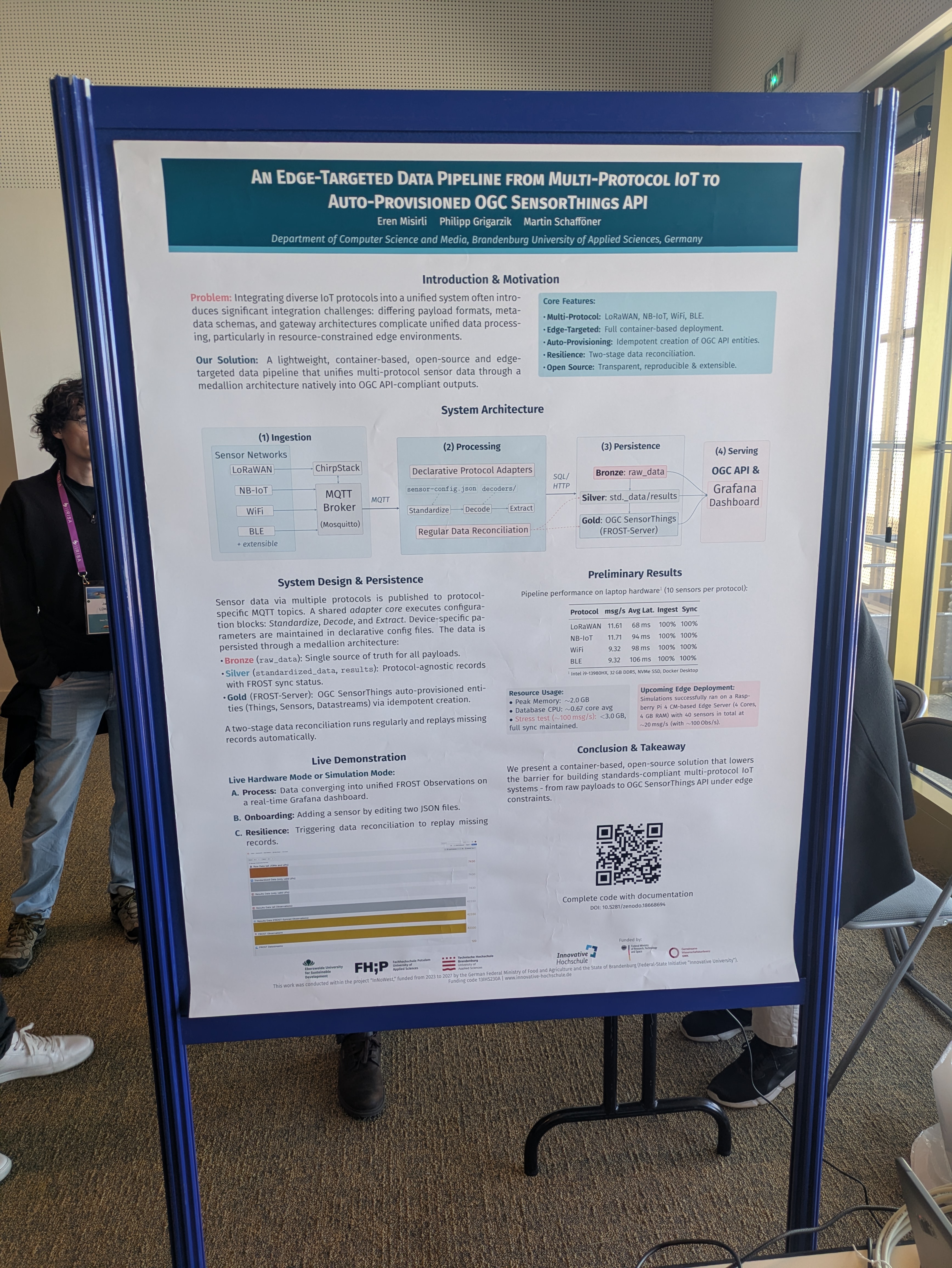
System for handling multiple sensor protocols. Can be useful for storing raw measurements with ENTS
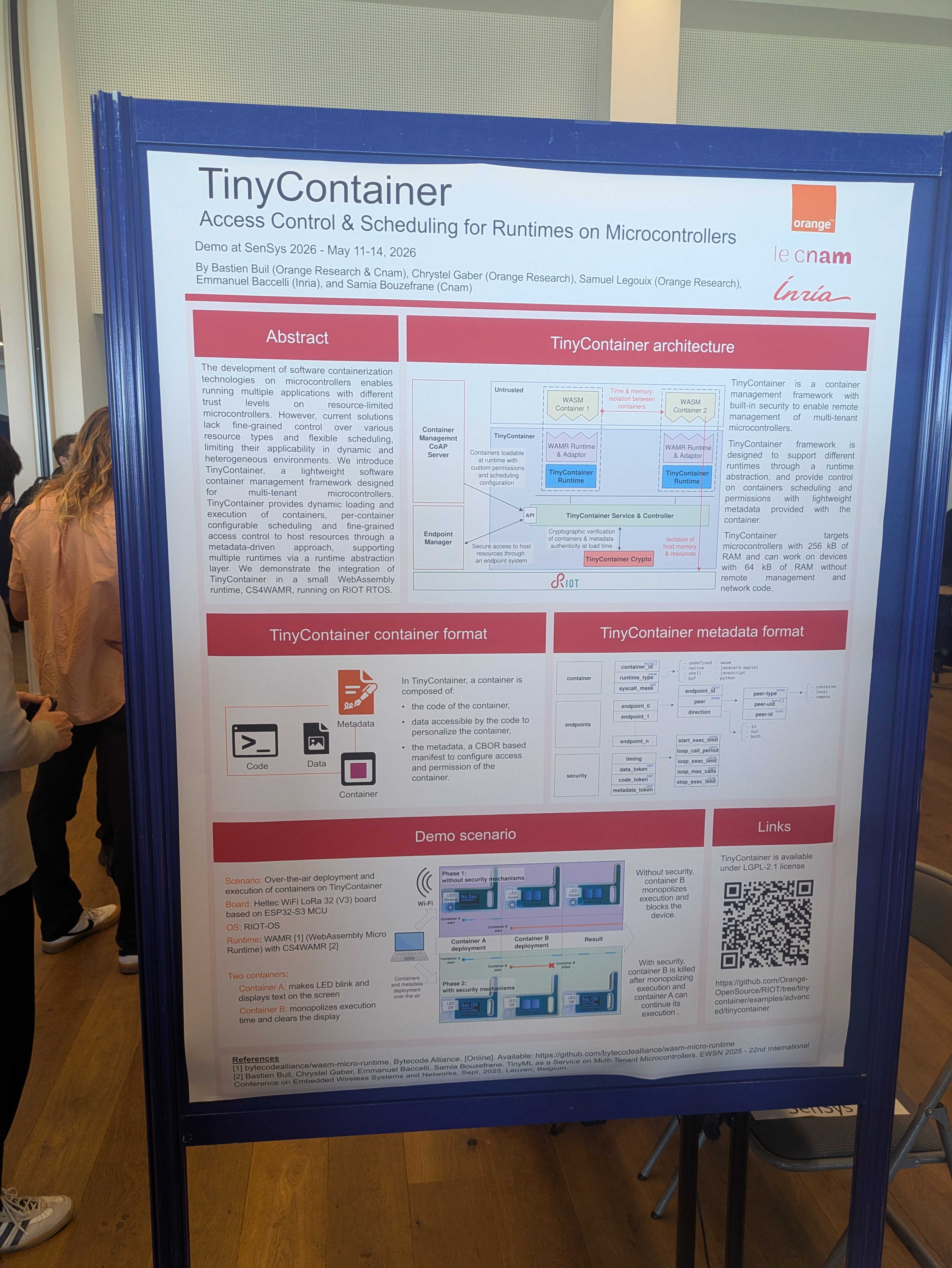
Multi-tenancy on embedded devices hosting web apps. Each app has it's own language interpreter that gives some form of isolation. Very similar goals to Tock. Gave example to run apps on infrastructure where multiple train companies share lines.
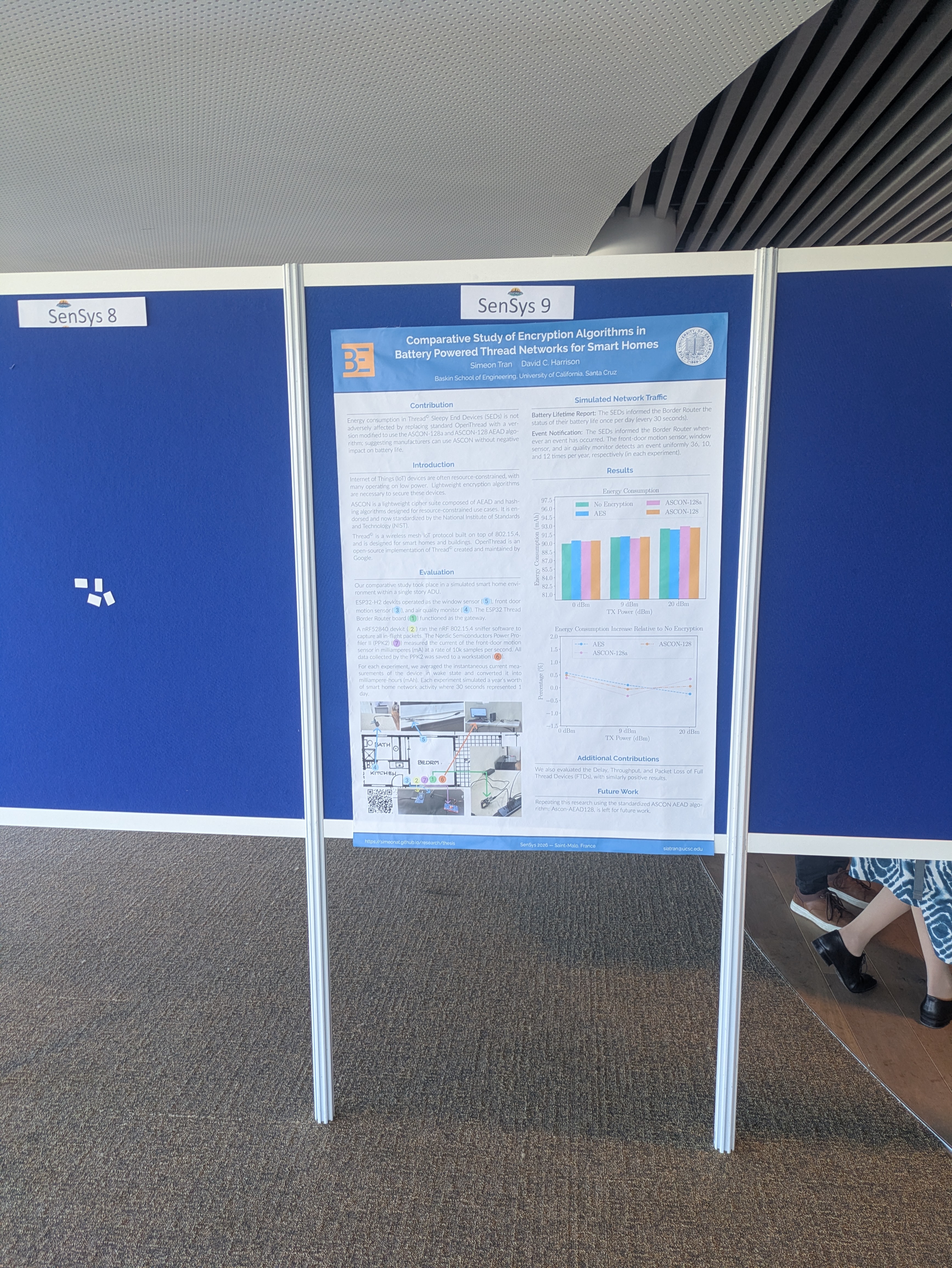
Another UCSC student sharing work on different encryption methods and the impact on performance and power consumption. Very similar work to the future of ENTS-tock where we are investigating the impacts of security.